
The CEO as a conductor of AI agents: from vision to governance
August 13, 2026 · 5 min read · Intelliway Team
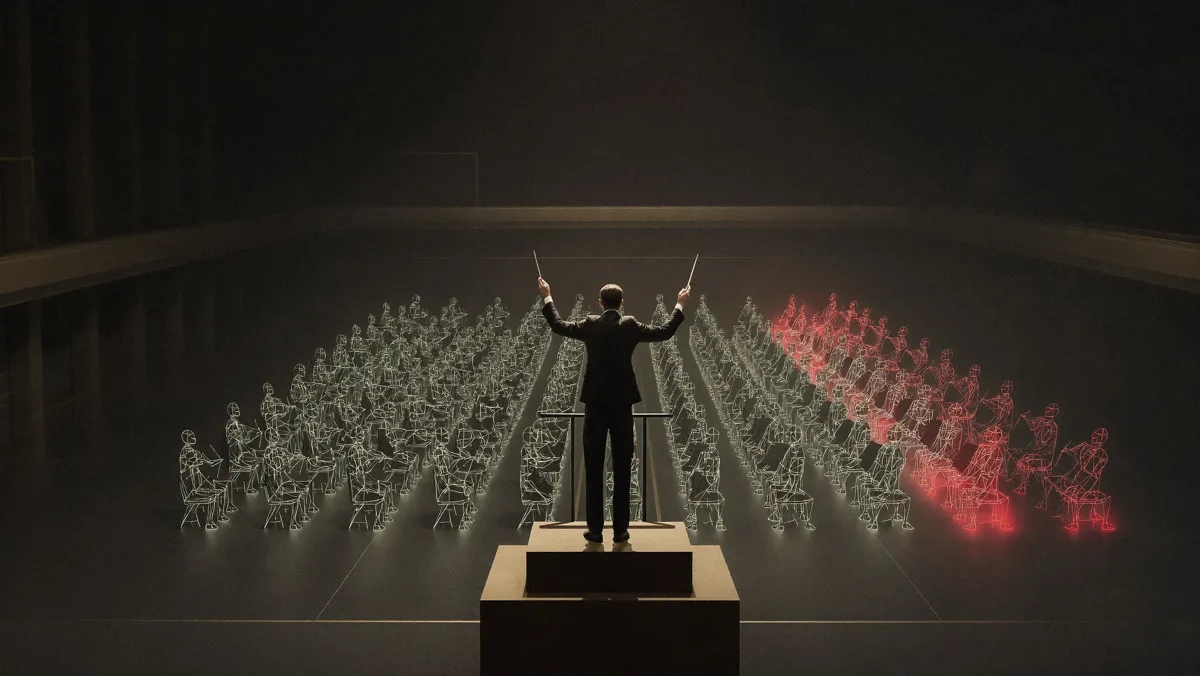
One idea became near instant consensus on the innovation stages of 2026: that today's executive should no longer use artificial intelligence as a tool, but instead conduct AI agents the way a maestro conducts an orchestra. Futurist Neil Redding, founder of Redding Futures, is one of the most articulate voices behind this thesis. In recent talks, he argues that leaders should stop treating AI as just another piece of software and take on the role of coordinating an ecosystem of humans and intelligent agents, each with its own function, within a shared context.
The analogy works because it is precise. A conductor plays no instrument during the concert. Their value lies in knowing the entire score, synchronizing sections that cannot see one another and deciding, in real time, what comes in, what falls silent and at what intensity. Redding offers a practical principle to get there, which he calls "delegate first": the default becomes assigning tasks to a set of agents, reserving strategic interpretation, supervision and the final decision for the human professional.
The metaphor is right. The problem is the stage
The risk of an elegant thesis is that it becomes a slogan before it becomes practice. And here the numbers tell the half of the story that rarely fits on stage.
Consulting firm Gartner projects that, by 2027, 40% of enterprises will demote or decommission autonomous AI agents, due to governance gaps that only become visible after an incident in production. In the same research, the firm estimates that 89% of agent pilots never reach real operation, while the 11% that survive deliver significant returns. Deloitte finds a similar picture from the other side: among the organizations surveyed, roughly 30% are only exploring agents, 38% are running pilots and just 11% have them in production.
In other words: orchestration is at once the inspiring vision and the exact spot where most stumble. Having many talented musicians does not produce music. It produces noise, if no one set the score, the limits of each section and the moment to stop.
Why orchestras of agents fall out of tune
Gartner's diagnosis of the cause of failure is the most useful detail for anyone leading this transition. Companies tend to treat agent governance as a binary switch: either the agent is locked down and useless, or it is unleashed and trusted. The structural error is failing to separate two distinct things, an agent's ability to act and the scope of access it is granted.
An agent can have enormous autonomy to execute within a small, well defined domain, and that is safe. The danger lives in granting broad access without the counterweights proportional to that reach. For higher autonomy agents, the recommendation is explicit: continuous monitoring, enforced guardrails, rollback mechanisms, circuit breakers that halt the process when something goes off script and a clear owner for each agent's behavior. The human stops reviewing every individual decision and starts reviewing exceptions, audit logs and aggregated outcomes.
Translating the metaphor: the conductor does not approve every note. They set the score, listen to the ensemble and step in when a section drifts off the beat. To do that, they need an orchestra that was rehearsed, with musicians who know their limits and a ruler to tell when the sound stopped being music.
From the stage to the operation
There is a direct parallel between this debate and what we already live in AI-operated security. A modern operations center does not put artificial intelligence in place to replace the analyst, but to take over triage and tier one investigation at a speed no human team can match, freeing the specialist for judgment and decision. The machine covers scale; the person covers depth. It is Redding's orchestration applied to a concrete case, and it only works because there is governance around it: traceability of actions, human oversight on critical decisions and clear limits on what the agent may do on its own.
This is exactly the gap between vision and execution that adoption data exposes. The inspiration of becoming a conductor is the easy part. The hard part, and the one that decides whether the project joins the 11% that work or the 40% that get decommissioned, is building the structure that makes orchestration trustworthy: usage policies, model observability, control over sensitive data, guardrails against improper behavior and a response plan for when an agent errs. It is no accident that this is what structures our AI governance (AI Trust) offering: observability, controls and compliance so that autonomy does not become risk.
What the leader takes from the concert
Redding's thesis is not wrong, it is incomplete if it stays at inspiration. Being a conductor of AI agents is the right destination, but no conductor takes the stage without a score, without rehearsal and without the ruler that says when the sound became noise.
For the executive building their first orchestra of agents, the practical script inverts the order of the hype. Start with governance, not with the number of agents. For each agent, separate how much it can act from how much it can access. Prefer high autonomy in narrow domains over broad access without counterweight. And keep the human where they truly add value, in the exceptions and the decisions that carry risk, not in reviewing every note.
The difference between a symphony and a chaotic rehearsal was never the talent of the musicians. It was always the conducting.
Want to structure the governance that sustains your AI agents before scaling the operation? Talk to the Intelliway team and get to know the AI Trust approach.