RAG in practice, how to bring generative AI to the enterprise without hallucinations
July 13, 2026 · 3 min read · Intelliway Team
The scene repeats itself in many companies: the generative AI pilot impresses in the demo, but in the first week of use someone asks about an internal policy and the assistant answers with absolute confidence... information that doesn't exist. It's the famous hallucination, and it's the number one reason enterprise AI projects die on the vine.
Why models hallucinate
Language models (LLMs) are trained to produce the most probable text, not the true text. They don't "know" what your company does, what your policies are or how much yesterday's shipping cost. When asked about something outside their training, they tend to fill the gap with something plausible, and plausible is not a synonym for correct.
For personal use, that's an inconvenience. For corporate use, with clients, contracts and regulation involved, it's an unacceptable risk.
What RAG is
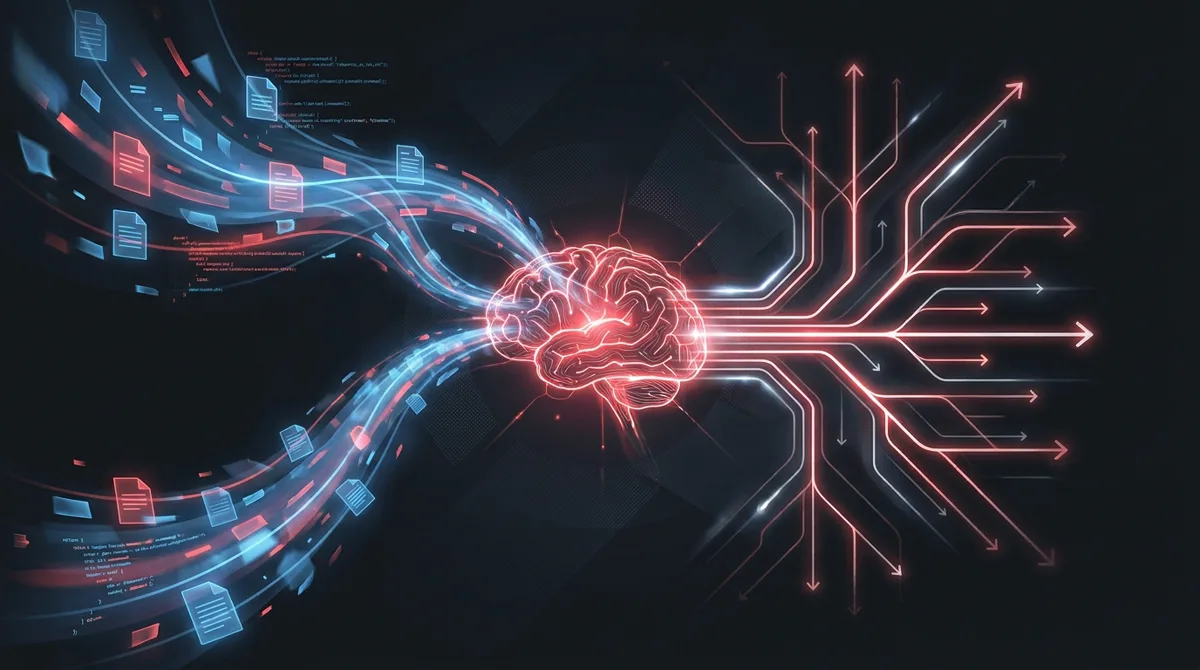
Retrieval-Augmented Generation changes the architecture of the answer. Instead of the model answering from memory:
- The user's question is turned into a search across the company's knowledge bases (documents, systems, databases);
- The most relevant excerpts are retrieved in real time;
- The model generates the answer anchored in those excerpts, citing the source.
The LLM stops being the source of truth and becomes the writer: what answers is your content. If the information doesn't exist in the bases, the agent says it doesn't know, behavior that seems simple but takes deliberate engineering.
What a well-built RAG requires
The acronym became a buzzword, but the difference between a prototype and a production RAG is in the details:
- Quality of the bases: an outdated indexed document is a wrong answer with a source. Curation matters more than volume;
- Indexing strategy: how documents are split, enriched and vectorized defines search precision;
- Permissions: the agent can't answer an intern with data only the board can access. RAG must respect access control at the source;
- Privacy: personal data must be anonymized before being sent to the model, a central point for LGPD compliance;
- Guardrails: scope limits and protection against prompt hacking prevent the agent from being manipulated out of its role;
- Observability: monitor answer quality, cost and drift in production, like any critical system.
RAG or fine-tuning?
A common question. Fine-tuning (retraining the model with your own data) teaches style and format, but is expensive, static and doesn't solve information that changes every day. RAG delivers up-to-date knowledge in real time and is auditable: you can see where each answer came from. For most corporate cases, RAG is the right starting point, and the two techniques can be combined when there is a real need.
Security and data sovereignty
Adopting generative AI can't mean sending the company's archive outside. The questions to ask any vendor:
- Is the data used to train third-party models?
- Is there a dedicated instance per client or a shared environment?
- Is there an on-premises option, with everything running in the company's datacenter?
- How is personal data handled with respect to the LGPD?
On Intelliway's EvaGPT platform, these answers shaped the architecture: dedicated instances, automatic PII anonymization, anti prompt-hacking filters and a 100% on-premises option, with RAG connected to the client's bases.
Conclusion
Reliable enterprise generative AI is not a matter of a bigger model, it's a matter of architecture: curated data, good retrieval, respected permissions and continuous monitoring. With production RAG, the assistant stops being a gamble and becomes infrastructure.
Intelliway implements RAG and enterprise AI agents with the EVA Platform, including an on-premises option. Talk to our team.