
The traditional SOC and Plato's cave: security or just shadows?
August 5, 2026 · 5 min read · Intelliway Team
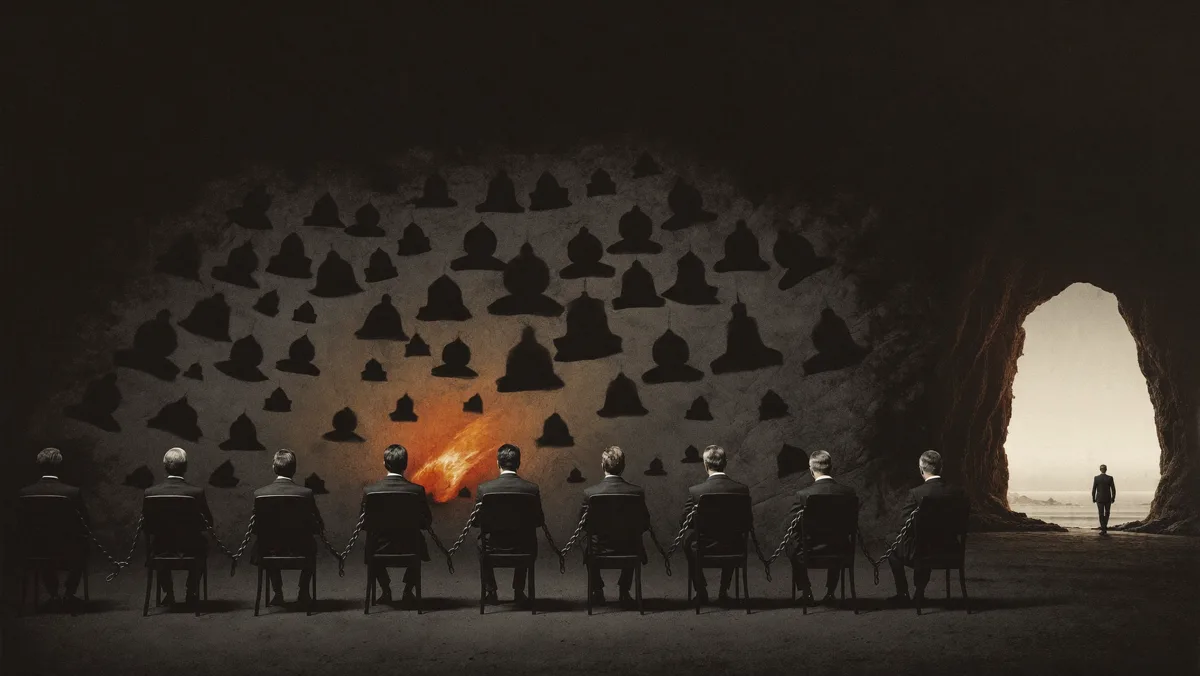
Every morning, thousands of IT leaders open their inbox and find the same landscape: dozens, sometimes hundreds of security alerts delivered by email. Subject line in caps, color coded severity, boilerplate text. Nobody investigated anything. Nobody contained anything. Yet the monthly report will say that 1,847 incidents were handled.
Plato described this exact scene 2,400 years ago.
The shadows on the wall
In the allegory of the cave, prisoners have lived chained since birth, with their backs to the entrance, seeing only shadows projected on the wall in front of them. Because the shadows are all they know, they take them for reality itself. Not for lack of intelligence: for lack of reference. Nobody misses what they have never seen.
The parallel with the traditional SOC is uncomfortably precise.
Mass email alerts are the shadows: distorted projections of events, with no context, no correlation, no response. The fire casting them is the static rule SIEM, which only recognizes what has already been written down. And the chains are the contract renewed out of inertia, the habit, the belief that managed security is simply this.
Customers do not stay in that model because they are naive. They stay because it is the only reality their provider ever showed them. When every report measures alert volume, alert volume becomes a synonym for protection.
How to recognize the cave
After years of conversations with companies running this model, the same sentences repeat with striking consistency:
- "I hired a SOC and nothing changed day to day."
- "All I get is a pile of meaningless alerts, always the same, with boilerplate text."
- "90% of what arrives is a user mistyping their own password."
- "My SOC did not detect the pentester I hired myself."
If any of those sound familiar, the honest question follows: does your SOC deliver security, or well formatted shadows?
One detail makes it worse: the adversary changed speed. Attacks today are automated, chaining valid credentials, lateral movement and exfiltration within hours. A model that depends on a human reading an email before reacting is not merely late. It is structurally blind to the middle of the attack, which is exactly where everything happens.
Leaving the cave is uncomfortable at first
In the allegory, the prisoner who breaks free feels pain when looking at the light. It takes time to see. And when he returns to tell the others, he is met with suspicion.
Leaving the traditional SOC cave causes the same discomfort. It means admitting that the last few years of monitoring measured the wrong thing. It means questioning a contract that was always formally in order. The resistance is human. But the cost of getting used to the shadows is silently accepting a risk that no committee ever approved.
The point often missed is that the way out is not buying another tool. It is not about bolting AI onto the same tired SIEM. It is about replacing the entire logic: from "I wait for the attack I already know" to "I learn what is normal and flag what departs from it".
The platform: visibility that does not depend on use cases
At Intelliway, this shift has two components working together, and it is worth separating what each one solves.
The first is the platform. Our AI-Driven SOC runs on Stellar Cyber, an AI-Native Open XDR that unifies in one place what used to live in separate consoles: SIEM, NDR for network traffic and OT environments, ITDR and UEBA for identity and behavior, automatic triage and an AI assisted investigator.
That unification attacks the root of the shadow problem. Behavioral detection combined with intelligent correlation cuts false positives significantly, because the platform learns the baseline of users, entities and network instead of waiting for a hand written rule. Onboarding new sources stops being a quarterly project: ingestion normalizes and enriches data automatically, without the ritual of manual parsers breaking every week.
Above all, alerts stop arriving loose. The platform groups events that belong to the same storyline and delivers a case with a beginning, a middle and an end, scored by risk. One case to investigate, not two hundred alerts to sift through.
The agents: operating at the adversary's speed
The second component is ISA Cyber, our own AI agent platform, running on top of that foundation. It does not replace the SIEM: it integrates with what already exists, including EDR, XDR, cloud and identity.
The agents take over triage and tier one investigation with 98.5% accuracy validated in operational testing, sustaining MTTD under one minute and MTTR around five minutes, 24 hours a day, without fatigue. The full cycle is covered: detection, notification, response, recovery, mitigation and remediation, with traceability and human oversight on critical decisions.
The practical effect is not turning the analyst into a spectator. Quite the opposite: they stop being an exhausted triager and go back to being the brain of the operation, deciding on what the machine has already contextualized. AI brings scale and speed, the specialist brings depth and judgment.
The first step out
No crossing starts with switching contracts. It starts with a question: where do I actually stand?
That is why we built the Maturity Assessment, free and without login. It is 30 questions and about 8 minutes, based on the NIST CSF 2.0 framework, and you immediately see your organization's maturity level, the score by area, the biggest gaps and a risk prioritized remediation plan.
If you want to dig into the current model first, the eight chronic problems of the traditional SOC are detailed in our e-book on the AI-Driven SOC.
Then look at your monthly report and ask your provider how many of those 1,847 incidents were investigated end to end. Ask to see a real case, with a timeline and a response.
The light hurts for the first few minutes. The darkness charges interest forever.
Want to see how the AI-Driven SOC works in your environment? Talk to our team and book a hands-on demo.